
Hybrid Fitness Didn't Come Out of Nowhere
 photo: @cortneyrohdefitness
How CrossFit, Obstacle Racing, and Endurance Sports Helped Create Fitness’s Newest Phenomenon
Led Zeppelin didn't just appear out of nowhere. Neither did the Rolling Stones. Trace either band backward and you'll find blues, early rock and roll, and artists who shaped the sound that came next. Trace them forward and you'll find entire generations of musicians who borrowed from them, changed the sound again, and created something new.
Fitness works a lot like that.
Right now, hybrid fitness is having its rock-and-roll moment. HYROX events are growing around the world. "Hybrid athlete" has become its own identity. Running and strength training are suddenly being talked about together as if somebody just discovered they make a pretty good combination.
But those of us who have been around obstacle racing for a while might be thinking:
Wait a minute. This looks familiar.
Because hybrid fitness didn't suddenly appear. Pull on the thread and you'll find CrossFit, obstacle course racing, endurance sports, functional fitness, and a whole lot of athletes who have spent years refusing to fit neatly into one category.
Today's hybrid athlete might be the newest branch of the family tree. But the roots go back a lot further.
CrossFit Turns Fitness Into a Sport
One of the easiest places to pick up the story is 2007. That year, roughly 70 athletes gathered at a ranch in Aromas, California, for the first CrossFit Games. The idea behind the competition was unusual at the time: instead of determining who was best at one specific discipline, athletes would be tested across a broad range of physical abilities.
The events could involve strength, running, rowing, gymnastics, work capacity, and more. Competitors didn't necessarily know exactly what they would be asked to do until it was time to do it.
In other words, being well-rounded wasn't preparation for the sport. Being well-rounded was the sport.
The idea caught on quickly. By 2011, the first worldwide CrossFit Open attracted more than 26,000 competitors, and CrossFit began an ESPN partnership that brought competitive functional fitness to a much larger audience. By 2018, more than 416,000 athletes were participating in the Open.
CrossFit had helped change the idea of what an "athlete" could look like. You didn't necessarily have to be just a runner, lifter, cyclist, or gymnast. You could train to be capable across all of it.
Then Fitness Went Outside
At almost exactly the same time, another branch of the family tree was taking shape.
Obstacle course racing exploded onto the scene around 2009 and 2010. Spartan held its first race in Vermont in 2010, and events like Tough Mudder were introducing huge numbers of people to an entirely different kind of competition.
Instead of barbells and pull-up rigs inside a gym or stadium, there were trails, walls, ropes, carries, crawls, water, hills, and plenty of mud. You still needed strength, endurance, and work capacity. But now you also had to keep moving for miles while dealing with terrain, weather, obstacles, wet clothes, wet shoes, and whatever the course decided to throw at you.
photo: @chad.rollins.9

OCR was hybrid fitness before "hybrid athlete" became something people put in their Instagram bios.
And this is where MudGear's story becomes part of the same family tree.
MudGear was founded in 2012 inside the growing OCR community. The original Tall Compression Sock wasn't created because the world needed another athletic sock. It was created because obstacle racers were shredding their legs on ropes and walls, soaking their feet in mud and water, and asking ordinary running gear to do things it wasn't designed to do.
The early days of Mud Runs and Obstacle Racing felt like a rebellion. For some of us, the world had become too packaged, processed, and safe. It was liberating to finally have a sport that was messy, raw, and a little unhinged. There was a primal energy at those races and a community in the athletes who loved it.
—Alex Thrasher, MudGear Founder
The sport created a new kind of athlete. That athlete created new problems to solve. And the gear evolved with it.
The Family Tree Gets Messy
Just like music, fitness genres don't stay neatly separated for very long.
CrossFit athletes started racing obstacles. OCR athletes realized they needed more running. Runners started lifting, and strength athletes started running. Trail runners added strength work. Ruckers combined load carriage with endurance. Functional fitness moved beyond any one gym or competition format.
And somewhere along the way, it became harder to answer a very simple question:
What kind of athlete are you?
For Cortney Rohde, that ability to move between disciplines is exactly what made hybrid training appealing:
What drew me toward hybrid training was realizing that I didn’t want to choose between being strong and being able to move well and have endurance. I love the challenge of lifting and getting stronger, but I also love running, conditioning, and testing what my body is capable of. There’s something really rewarding about being able to lift heavy, run hard, and still feel like a well-rounded athlete.
— Cortney Rohde, NASM CPT & CNC, Personal Trainer & Nutrition Coach
Maybe you lift three days a week and run twice. Maybe you train for an obstacle race, but your weekends are spent hiking. Maybe you ruck, strength train, and occasionally sign up for a 10K.
Maybe you're not competing at all. You just like being strong enough, fit enough, and conditioned enough to say yes when someone suggests doing something difficult.
For a growing number of people, the labels became less useful because the training started overlapping.
OCR Was Already Showing Us Where This Could Go
This is one reason the current hybrid movement feels so familiar to longtime obstacle racers. OCR never really allowed athletes to specialize completely.
Being an exceptional runner helped—until you reached an obstacle requiring strength or grip. Being incredibly strong helped—until you had to carry that strength across miles of running and elevation. The best athletes had to find the balance.
Strength without endurance had limitations. Endurance without strength had limitations. And both had to work when the athlete was tired.
That's remarkably close to the conversation happening around hybrid fitness today.
The difference is that the format has evolved.
Enter HYROX
In 2017, HYROX launched in Hamburg, Germany, and took many of these familiar ingredients in a different direction. The format is remarkably straightforward: run one kilometer, complete a functional workout station, and repeat that pattern eight times.
Every HYROX race follows the same basic structure, and that's a significant difference from both CrossFit and OCR. CrossFit competition has historically embraced variety and the unknown—you train broadly because you don't know exactly what you'll be asked to do. OCR gives you another kind of uncertainty, where terrain, obstacles, weather, elevation, and course conditions can all influence the race.
HYROX made the test standardized. You know what's coming. You can train specifically for it, race it again, and compare your performance.
And perhaps most importantly, you don't have to be an elite athlete to participate. There are different divisions, no qualification requirement for standard participation, and HYROX reports that more than 98% of entrants finish their race.
It sits somewhere between a road race and a functional fitness competition—and that may be exactly why it has found such a large audience.
photo: @dixiebonner

Did Hybrid Fitness Find the Sweet Spot?
There's an interesting question hiding in HYROX's growth: Did hybrid fitness take some of the most appealing pieces of the sports that came before it and make them easier for more people to access?
CrossFit demonstrated that fitness itself could be competitive. OCR proved there was a huge appetite for events that demanded both strength and endurance. Traditional running demonstrated the power of a standardized distance, a finish line, a personal time, and the ability for everyday athletes to compete on the same course as exceptionally fast ones.
Hybrid racing brings pieces of all three together.
And people are responding. HYROX launched in 2017 and has grown particularly rapidly in recent years. By the 2025–26 season, participation had reportedly surpassed 1.4 million globally.
That's a long way from a niche fitness experiment. But calling hybrid fitness completely "new" misses the more interesting story.
This is evolution, not invention.
The Athlete Evolved, Too
The most interesting part of this story may not be what happened to the sports. It's what happened to us.
There was a time when being a runner generally meant you ran. A lifter lifted. An obstacle racer trained for obstacles. Those distinctions still exist, of course, and specialization matters when you're trying to become exceptionally good at something.
But for a huge number of active people, fitness no longer needs to fit into one box. People want to run and be strong. They want to lift and have endurance. They want to race one weekend, hike the next, and still be able to carry something heavy without needing three business days to recover.
For competitive athletes, that versatility can be part of performance. For the rest of us, it might simply be a useful way to live. And sometimes, being a well-rounded athlete is less about what's next on the race calendar and more about being ready when an opportunity comes along.
Opportunities can come up without much notice and I like to be able to take them when I can. Plus I enjoy what I do for my training/workouts and it’s very sustainable so I can stay consistent with the routine even with a baby and running a household and business.
—Corinna Perkins, MS, RD, CSSD, Sports Performance Dietitian
The RD Athlete
The Gear Had to Evolve, Too
We've watched the same evolution happen at MudGear.
Our roots are still very much in OCR. Mud, water, ropes, trails, long miles, and tough conditions taught us a lot about what performance gear needs to do when things get uncomfortable.
But the athletes who wore MudGear didn't stay in one lane. They took us trail running, rucking, hiking, into gyms, endurance events, and now hybrid competitions. And plenty of people started wearing the same gear simply because they spend a lot of time moving or working on their feet.
The individual demands can be different, but the fundamentals haven't changed much. Moisture still matters. Friction still matters. Fit still matters. Durability still matters. And the longer you're moving, the more annoying a tiny gear problem can become.
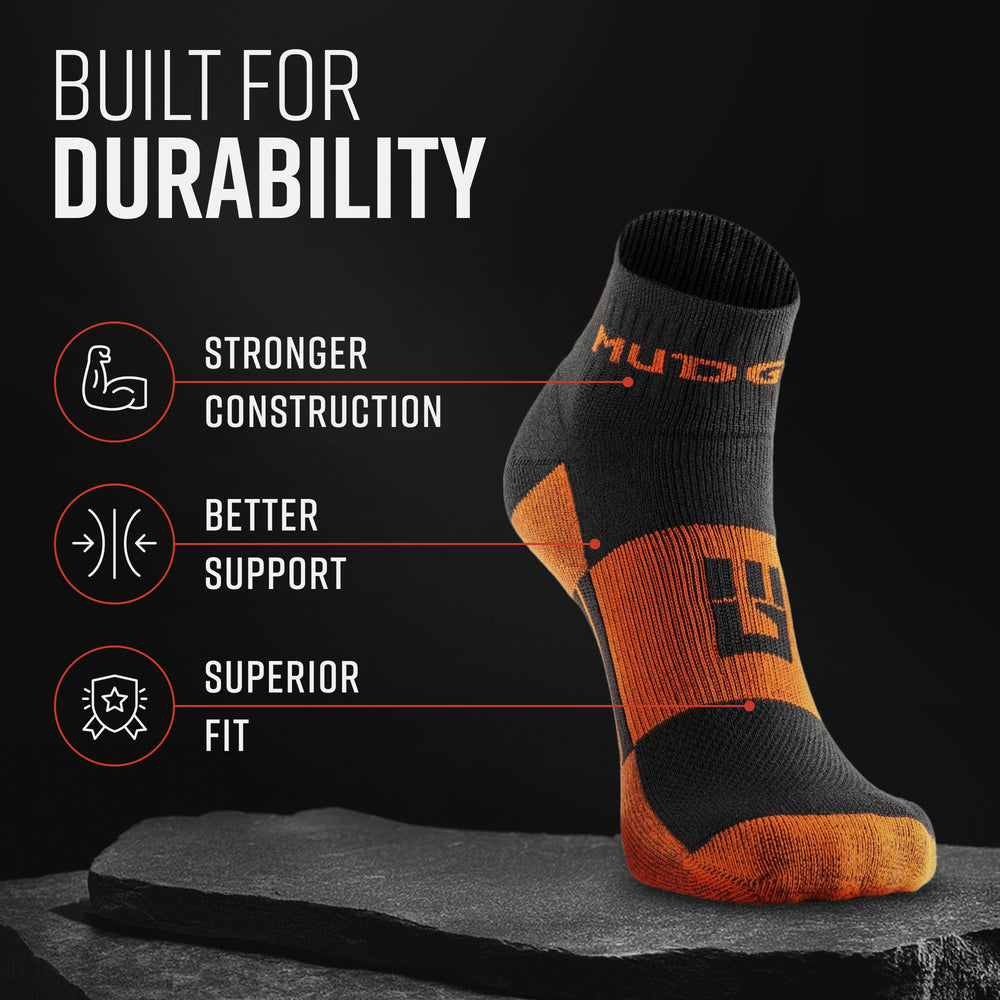
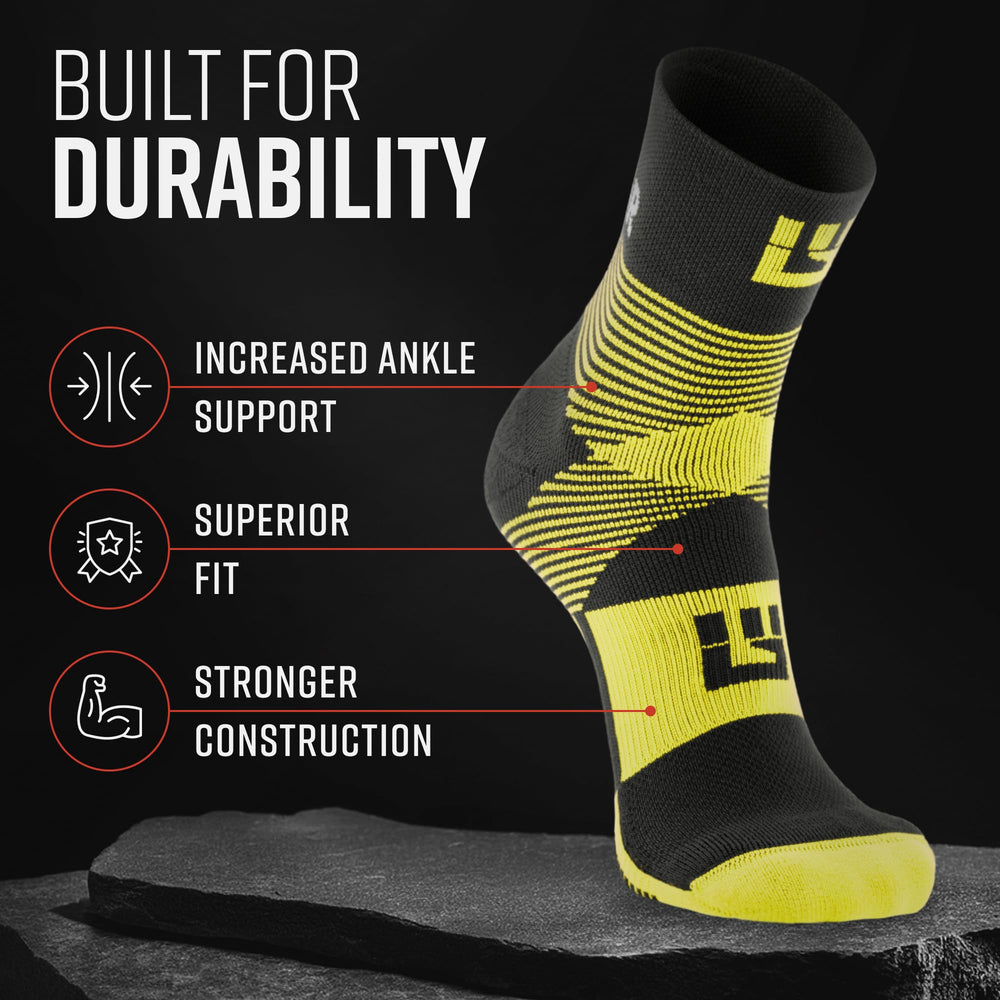
That's why the products have become more specialized, too. A lightweight Running Sock doesn't need to be built exactly like a Ruck Sock. A Hiking Tall Compression Sock serves a different use case than a Hybrid Training Sock. What works for a long trail day may not be what you reach for in the gym.
For Alex, watching the gear evolve has gone hand in hand with watching the athletes—and the sports themselves—continue to evolve:
I love watching the evolution of these sports and how they intersect. In Hybrid Fitness Racing, you can trace the racing styles of particular athletes and watch how someone with an OCR background competes with someone from a CrossFit background or a mountain endurance background, and these hybrid athletes are going to take their pedigree into whatever comes next. Our job remains the same, we want to make the best socks and gear for whatever new challenges our customers take on.
Different branches. Same family tree.
So, Did Hybrid Fitness Eat OCR and CrossFit's Lunch?
Not exactly. And that's probably the wrong way to look at it.
Rock didn't disappear when heavy metal showed up. Blues didn't disappear when rock and roll took off. One genre influenced another. New generations borrowed what worked, changed what didn't, mixed in something different, and created a sound that belonged to them.
Fitness seems to work the same way.
CrossFit didn't disappear when OCR exploded, and OCR isn't disappearing because hybrid racing is growing. Running certainly isn't going anywhere. Instead, you can draw a line through all of them.
CrossFit helped turn broad physical capability into a competitive sport. OCR took strength and endurance into unpredictable outdoor environments. Running and endurance sports brought pacing, measurable performance, and mass participation. Hybrid fitness borrowed from all of it.
And now another generation of athletes is deciding what comes next.
Full Circle
There's something especially interesting about watching this happen from MudGear's perspective.
In 2012, we started making gear for a relatively new breed of athlete—someone who needed to run, climb, carry, crawl, endure, and keep moving when conditions got ugly.
Fourteen years later, the terminology has changed. The events have changed. The training has changed.
But the idea behind it all feels remarkably familiar: Be strong. Have endurance. Be adaptable. And be ready for whatever comes next.
Maybe hybrid fitness isn't as new as we think.
Maybe it's just the next branch on the tree.
SOURCES & REFERENCES
CrossFit Games. History of the Games.
Spartan. The 10 Most Important Spartan Races of the Past 10 Years.
HYROX. The History.
Financial Times. Investors led by L Catterton to buy controlling stake in Hyrox. September 8, 2026.
MudGear. About Us / MudGear Innovations.





Leave a comment